Xfinity/Parks study finds that 41% of apartment renters expect immediate access to broadband
Key Highlights
- 41% of apartment renters expect their internet service to be ready upon move-in, influencing their leasing choices.
- Nearly 50% of residents rate internet availability at move-in as a top consideration when searching for a new home.
- Property owners are adopting smart devices like locks, thermostats, and leak detectors to enhance resident experience and operational efficiency.
- Robust broadband connectivity is a key differentiator for multifamily properties, helping attract and retain tenants.
- The white paper offers best practices for simplifying smart tech implementation and achieving seamless property readiness.

When a resident is considering which apartment to rent, broadband availability is a top priority.
Broadband is essential not only for remote workers but also for enabling key amenities such as property-wide security cameras and controlled access; robust connectivity is required.
A new joint Parks Associates/Xfinity Communities white paper, "Achieving Turnkey Connectivity: Elevating the Total Multifamily Experience," showed that 41% of apartment renters expect their internet service to be ready-to-go from the moment they move into a property.
Developed in partnership with Xfinity Communities, the white paper examines how properties can enable turnkey property readiness and a seamless move-in experience for residents. It addresses the growing challenges posed by vendor fragmentation and outlines best practices for simplifying smart technology implementation.
Nearly 50% of apartment residents rated internet availability at move-in as a top consideration when searching for a new home.
Having robust broadband available is also a tool that multifamily property owners and managers can use to differentiate themselves. Parks Associates estimates that there are nearly 29 million apartments and almost 10 million condos in the United States.
Increasingly, property owners and operators seek technologies to attract and retain residents, enhance Net Operating Income (NOI), and protect their assets. Devices such as smart locks, thermostats, leak detectors, and lights are becoming increasingly common in multifamily settings.

Elizabeth Parks, President and Chief Marketing Officer at Parks Associates, noted that when examining the role of multifamily connectivity, consumers view it differently within multifamily units.
“There’s a transition and transformation that’s happening in the multifamily market,” she said. “There’s an evolution for consumers because of technology advancements, and that’s spilling over into not only the multifamily experience in the units, but also what’s outside in the public areas.”
Housing market evolutions
The housing market is a significant factor in the evolution of multifamily housing and reflects who can afford to buy a house. Additionally, a shrinking population affects housing and overall growth across consumer markets.
Ilan Eframian, VP, Xfinity Communities, said the demographics of renters continue to evolve. “Over half of the renters are over the age of 45,” he said. A lot of people who are not familiar with the multifamily thing are people renting before they buy a house, and that’s not the case anymore.”
This shift reflects several factors. For example, young and older adults have different needs and desires for technology and housing than they did 10 years ago.
The median person living in an apartment building is not the 23-year-old right out of college. Eframian said it is a 45-year-old with children whose connectivity needs differ from those of 10 years ago.
However, among younger residents, the expectation of instant Wi-Fi access is a significant issue.
Regardless of the specific group, Eframian said, “the age piece drives all of this.”

A consultative approach
When it comes to offering managed services to MDUs, Xfinity takes a consultative approach. The service provider’s internet services are either provided by property owners or available for individual residential purchase.
With Xfinity Communities' internet services, customers receive pre-installed internet equipment in their unit and immediate connectivity on the day of move-in.
One of the key products Xfinity offers is managed Wi-Fi. Managed Wi-Fi is a solution that outsources wireless network management to a third-party provider.
With a pre-installed Xfinity Wi-Fi Gateway in every unit, residents have instant access to the internet upon moving in. Residents can sign up for Xfinity Internet upon arrival, lease the Xfinity WiFi Gateway, and get connected immediately.
“When we talk about bulk and connectivity, we’re more agnostic to the technology side of it,” Eframian said. “With managed Wi-Fi, there’s a focus on new construction.”
Retrofit challenges, opportunities
While Xfinity is finding its managed Wi-Fi footing with new properties, installing it in an older property presents challenges, including the need to install equipment and facilities to route cabling to Wi-Fi devices.
While Xfinity is happy to provide managed Wi-Fi services to an older property, there are other solutions it could offer that are less disruptive to residents and property staff.
Earlier this year, Xfinity Communities debuted Connected Building, an end-to-end networking solution designed to deliver always-on, property-wide Wi-Fi. The company, which is offering Connected Building in bulk deployments, with additional options launching later in 2025, claims that the service is less expensive than traditional managed Wi-Fi solutions. This is because it can leverage the existing building’s coax facilities.
“To retrofit a building with managed Wi-Fi, theoretically, there might be a need, but the Connected Building product is something that can get most of the things that people want from managed Wi-Fi without having to be invasive by opening the walls,” Eframian said. “Using the existing coax that’s there, we can give the gigabit and multi-gigabit speeds with ubiquitous Wi-Fi and the foundation to enable property technology applications.”
Property technologies like leak detection, connected thermostats, and the Connected Building product can support onboarding.
Eframian said, “Property tech elements are great, but they need sensors and connectivity to work, so it solves for a lot of other problems operationally.”
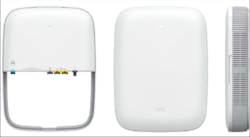
In a Connected Building environment, Xfinity is equipping MDUs with its MXB1 Wireless Gateway, a flat, wall-mountable version of the XB8 router.
Designed for retrofit environments in the multifamily segment, MXB1 enables building owners to support additional networks that power Smart technologies and provide residents and staff with Wi-Fi access in any location within a property.
“The MXB1 focused on retrofits,” Eframian said. “For the normal property to have some of these technologies, this solution allows for property-wide connectivity.”
In addition to providing immediate internet access to current residents, the platform enhances operational efficiency. When a new resident moves, they can sign in to the network without scheduling an installation appointment.
“Because the router is wall-mounted, when a resident moves out, the router stays there, and the connectivity stays on,” Eframian said.
The platform has four SSIDs. One of the SSIDs changes from the former resident to the new resident. Other SSIDs are dedicated to guest access, Xfinity Mobile connection, and a fourth for property staff.
“In the past, you would have to have a full managed Wi-Fi solution to get those things,” Eframian said. “Now, this is a normal part of the plan as part of a bulk option and we’ll also have a retail option.”
He added that “what’s nice about having that retail and bulk flexibility is if another regulation comes through, we can make that pivot.”
Bulk service acceptance shift
Another factor that continues to influence the MDU broadband market is bulk services.
In a bulk services agreement, where property owners (apartments, HOAs) pay an ISP for internet for all units, offering residents lower costs, instant setup, and guaranteed speeds, often with upgrade options, while providers get bulk revenue and easier management, with options ranging from standard bulk internet to community Wi-Fi.
Under a standard bulk agreement, each unit receives its own connection (e.g., fiber or cable) with individual logins, like retail service.
There are benefits for residents and property owners. Residents have access to lower-cost service, instant activation, consistent speeds, dedicated support, and the ability to upgrade to higher speeds. Likewise, property owners get revenue from the provider, increased property value/attractiveness, streamlined operations, reduced resident complaints.
Parks found in a related study that although resident preference is a top priority for MDUs, “there is a higher focus on direct profitability than in prior years.”
While bulk service trends have evolved over the past decade, the service remains popular among MDU residents.
“Some residents are hesitant about bulk, but once they have experience with it, if they move to another property, they embrace it because they have become accustomed to it,” Eframian said. “This is a big shift going back 10 years ago, where bulk was mainly for student or senior housing; it has become more ubiquitous.”
Enhancing MDU operations
Consumers aren’t the only ones affected by broadband availability. Property owners and managers need broadband connectivity for backend operations.
A lack of suitable pre-existing networking infrastructure is a top barrier to the widespread deployment of IoT by MDUs. Many existing properties were built without adequate wiring or the infrastructure to support new wiring.
Additionally, many properties do not own the wiring infrastructure, making new connectivity deployments costly or not feasible. As a result, older properties are far less likely to offer smart amenities and are more likely to experience issues with their existing infrastructure.
“Operationally, for property owners and technology managers, technology will take over everything and how they are operating, and it has already taken over in some ways,” Parks said. “Now, it’s a matter of integration and convergence, and all of that must be built on a solid foundation of connectivity and Wi-Fi throughout the buildings that are reliable.”
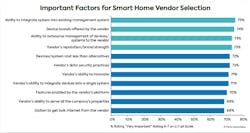
The Parks white paper found that a large majority of survey participants (75%), cited integrating propety technology into an existing management system was a key issue.
Multifamily properties and MDUs are increasingly embracing technologies and connected use cases to meet the needs of their residents better and to improve their own internal operations across three main vectors:
Staffing: Property staff can leverage virtual platforms to show units remotely to prospective residents, with access control systems enabling self-guided tours. By using automated systems, a property company can schedule cleanings, inspections, and repairs, reducing downtime between tenants. Additionally, access control systems avoid the need to rekey locks or change codes during resident turnover.
Energy: The emergence of smart thermostats and smart appliances has become accepted as an amenity for residents and as a cost-cutting tool for property owners. For example, properties are using connectivity to control the thermostat and lighting in vacant units. Parks suggests that to realize full operational benefits, smart thermostats must be deployed in a managed Wi-Fi or building-wide Wi-Fi scenario.
Additionally, properties can incorporate connectivity to manage major energy-related systems, including HVAC, solar/storage, generators, and electric vehicle (EV) charging. While U.S. EV penetration is low, with 6% of MDU households reporting owning an EV, Parks suggests that EV charger availability is on residents’ minds, with 36% claiming they are valuable in a prospective home.
“Many renters, particularly in urban areas, anticipate owning an EV in the coming years and are looking for apartments that can offer charging on-site if needed,” Parks said in the white paper.
Insurance: Multifamily property owners continue to face rising insurance costs. TBM Multifamily noted that property insurance rates went up 10% to 40% for multifamily property owners. Parks cited how multifamily property owners could leverage connectivity to water leak detectors with shutoff valves as an example of how smart building management can mitigate risk by identifying leaks that increase water consumption costs. Water leak detectors are being deployed across all property types, but Parks said they are particularly valuable in high- and mid-rise buildings, where leaks can cause even more damage.
On the operational side, owners and operators seek property technology that can reduce costs, and applications are built on connectivity.
Despite the promise of new property technologies, Parks said that integrating different systems remains a challenge for complex owners and operators.
“What we saw at Parks from talking to owners and operators is what we are investing in,” she said. “What will it do for me, and how will it save me money, and will it be easy for my team to operate, so you need to have a product that you can move people in and out of and understand it, and it all works reliably.”
Parks added that the way MDU technology has come under a different lens. “There’s a lot of savings, but there’s also investments where they must figure out a new model on net operating and different metrics that weren’t there 10 years ago,” she said. “All of these properties are incredible assets with the opportunity to have upgrades that could have additional revenue streams and differentiate the property in a relatively easy way when you talk about the internet.”
For related articles, visit the Broadband Topic Center.
For more information on high-speed transmission systems and suppliers, visit the Lightwave Buyer’s Guide.
To stay abreast of fiber network deployments, subscribe to Lightwave’s Service Providers and Datacom/Data Center newsletters.
(This article was updated with additional information from Parks Associates and Xfinity Communities.)
About the Author

Sean Buckley
Sean is responsible for establishing and executing the editorial strategy of Lightwave across its website, email newsletters, events, and other information products.